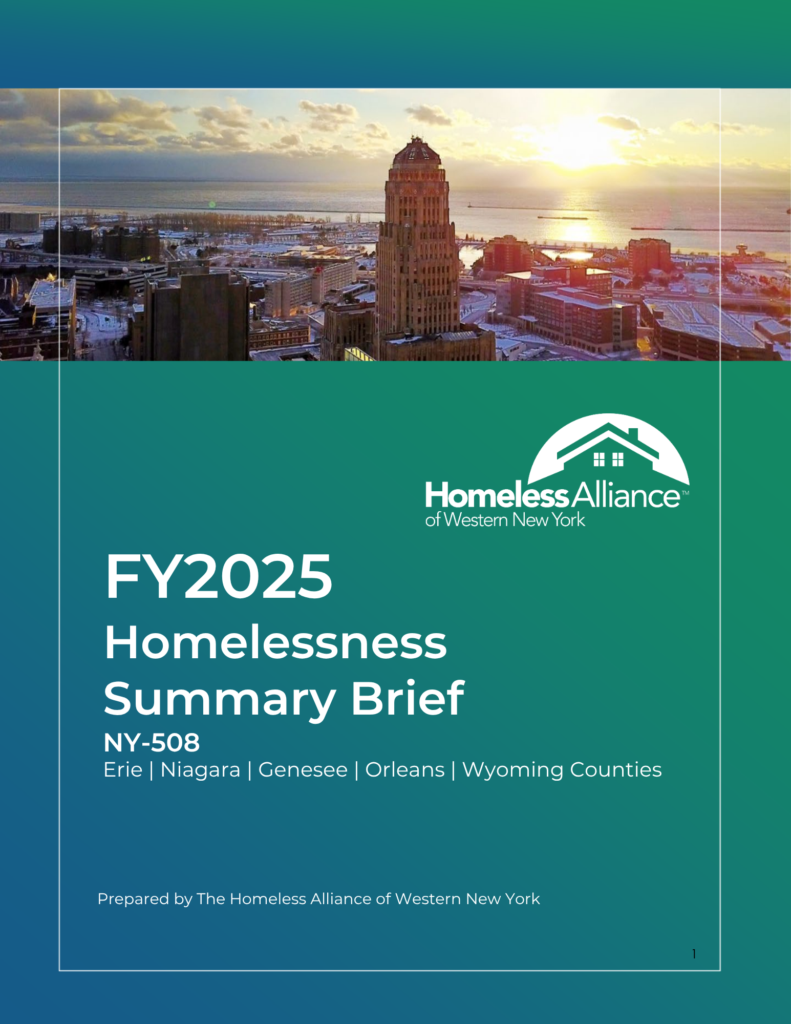
The new Homeless Alliance of Western New York annual report points to an affordable housing crisis that is pushing more households into homelessness faster than the community can house them in FY2025.
FY2025 HOMELESSNESS SUMMARY BRIEF
BUFFALO, N.Y. — An estimated 8,602 people experienced homelessness across Western New York in FY2025, according to the latest annual report from the Homeless Alliance of Western New York. But behind the total number is a more significant finding: 76.9% of people entering the region’s homeless response system were experiencing homelessness for the first time, as the affordable housing crisis continues to push more households into housing instability across the region.
The report also confirmed a long-term trend, finding an 8.0% increase in the number of people experiencing homelessness across Western New York from FY2015 to FY2025.
The FY2025 Homelessness Summary Brief, which examines homelessness across Erie, Niagara, Genesee, Orleans and Wyoming counties, shows that more people are entering homelessness even as the region’s homeless response system continues to produce positive results. Exits to permanent housing increased during FY2025, while the rate of people returning to homelessness within six months of exiting to a permanent housing situation remained stable.
“The data tells us the system is working, but it’s working against a housing crisis that’s becoming increasingly difficult to overcome,” Nate Pyzikiewicz, HMIS Director at the Homeless Alliance of WNY said. “Our service providers are doing a good job helping people find housing and regain stability with the resources they have. The challenge is that more people are entering homelessness, most for the first time and faster than our system can help them, and there isn’t enough affordable housing to meet that need.”
A Housing Crisis Is Driving More People Into Homelessness
The report points to housing affordability as a central factor behind the region’s growing homelessness crisis. Nearly half of Western New York renters (49.5%) are spending 30% or more of their income on rent, a level defined by the U.S. Department of Housing and Urban Development (HUD) as unaffordable. At the same time, 34% of clients identified eviction as the primary reason they became homeless, making it the leading reported cause in the region.
Among clients who reported a primary reason for losing their housing, 23.4% cited an informal eviction, while 12.8% cited domestic violence or abuse and another 10.6% cited a court-ordered eviction. Loss of job or income, including public benefits, accounted for another 8.0%.
“Homelessness is not simply someone sleeping outside,” Tracy Schmidt, Director of Community Impact said. “Especially in today’s economic climate, homelessness is one crisis away for a lot of people. It can begin when a family’s car breaks down the same week rent is due, when someone’s hours at their job are cut back, or when another crisis makes it extremely difficult to remain housed. The fact that more than three-quarters of people entering the homeless response system are experiencing homelessness for the first time should challenge all of us to think differently about who homelessness affects and what it actually looks like.”
The System Is Working, But Needs More Housing
Despite the growing demand, the report finds that the region’s homeless response system continues to help people move toward permanent housing.
In FY2025, 1,694 people exited a NY-508 homeless service provider to a permanent housing situation, representing 28.9% of all clients who exited the system. The proportion exiting to a permanent housing situation increased from FY2024, even as the overall number of people experiencing homelessness also increased.
However, the lack of affordable housing is making it harder for providers to build on those successes. As more people are priced out of housing and fewer affordable units are available, people already receiving services are staying in shelters longer while providers work to find permanent housing.
“When someone is able to remain housed, that is a win for the entire community,” Schmidt added. “It means a family avoids the disruption and trauma of homelessness, a child can remain in their school, a person can remain connected to their job and community, and our homeless response system can focus its resources on people who truly need crisis intervention. Prevention isn’t just good policy, it’s an investment in the stability and well-being of our entire community.”
The People Behind the Numbers
The data in the latest annual report represent more than a year-over-year increase. They represent families, children, people living with disabilities, survivors of domestic violence and community members who can spend months navigating homelessness while searching for a place they can afford to call home.
In FY2025, 971 families experienced homelessness across Western New York, continuing an upward trend that began in FY2021. Children accounted for 26.9% of all people experiencing homelessness in the region, meaning more than one in four people experiencing homelessness was a child.
People living with disabilities are also disproportionately represented among those experiencing homelessness. Nearly half (46.7%) of people experiencing homelessness were experiencing a disability, compared with 14.3% of the overall NY-508 population. For someone already facing the challenges associated with a disability, losing stable housing can make accessing employment, health care, transportation and other essential supports even more difficult. At the same time, nearly half of Western New York renters are already spending at least 30% of their income on rent, making the search for an affordable home even more difficult.
The data also reveals significant racial disparities. Black, African American or African residents represented 48.5% of people experiencing homelessness, compared with 10.6% of the overall NY-508 population.
For some, homelessness is the result of an immediate and dangerous crisis. 581 people identified domestic violence or abuse as their primary reason for losing their housing in FY2025, 12.8% of clients reporting a primary reason for homelessness. That represents a 34.5% increase from the previous year, when domestic violence accounted for 9.5%.
And for thousands of others, homelessness is not brief. 4,301 people experienced Long Term Homelessness in FY2025, defined in the report as experiencing homelessness for more than 92 days within the NY-508 Continuum of Care.
Behind every number is a person trying to regain stability, a parent trying to keep their family together, a child trying to maintain a sense of normalcy, a survivor trying to find safety, or a person with a disability trying to navigate a housing market that may not offer an affordable option.
That is why preventing homelessness before it happens matters. Keeping someone housed is not only better for that individual or family, it reduces the disruption homelessness creates throughout our community and allows our homeless response system to focus resources on people who need them most.
What Can the Community Do?
Homelessness cannot be solved by homeless service providers or a single organization alone. Expanding affordable housing, preventing homelessness before it occurs, improving access to existing housing and investing in supportive services are all necessary to make homelessness rare, brief and non-recurring.
The report specifically recommends expanding the supply of affordable housing, strengthening eviction prevention and emergency rental assistance, increasing housing navigation and landlord partnerships, expanding permanent supportive housing and continuing investment in the region’s existing homeless response system.
And addressing homelessness requires the entire community to better understand what homelessness looks like in WNY and the role each of us can play in addressing it.
“Ending homelessness is not just about helping someone after they lose their home,” Ashley Matrassi, Director of CoC Programs said. “It’s about creating communities where people have a real opportunity to remain housed in the first place. That takes all of us, from community members and nonprofit organizations to businesses, landlords, elected officials, health care providers and others. When we invest in keeping people housed, we are investing in stronger, safer and more stable communities for everyone. We all want communities where everyone can be safe and have a place to call home.”
“Behind every number in this report is a person — someone’s mother, father, child, friend or neighbor,” Matrassi concluded. “These are members of our community who deserve safety, stability and a place to call home. If we truly want to reduce homelessness, we cannot only focus on helping people once they become homeless, we have to do more to keep people housed in the first place. Strong communities take care of their neighbors, and that means making sure people have a real opportunity to remain safely and stably housed.”
The Homeless Alliance encourages community members, organizations and local leaders to review the FY2025 Homelessness Summary Brief to better understand the scope of homelessness across Western New York and the solutions needed to address it. The full FY2025 Homelessness Summary Brief can be found here.